

|
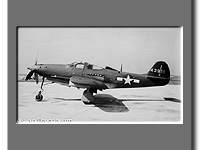
Description
| Manufacturer: | Bell |
| |
| Base model: | P-39 | ||
| Designation: | P-39 | ||
| Version: | Q | ||
| Nickname: | Airacobra | ||
| Designation System: | U.S. Air Force | ||
| Designation Period: | 1925-1947 | ||
| Basic role: | Pursuit | ||
| Crew: | Pilot | ||
| See Also: | P-45 | ||


Specifications
| Length: | 30' 2" | 9.1 m | |
| Height: | 12' 5" | 3.7 m | |
| Wingspan: | 34' 0" | 10.3 m | |
| Wingarea: | 213.0 sq ft | 19.7 sq m | |
| Empty Weight: | 5,680 lb | 2,575 kg | |
| Gross Weight: | 7,651 lb | 3,469 kg | |
Propulsion
| No. of Engines: | 1 | ||
| Powerplant: | Allison V-1710-85 | ||
| Horsepower (each): | 1200 | ||
Performance
| Range: | 650 miles | 1,046 km | |
| Max Speed: | 382 mph | 615 km/h | 332 kt |
| Ceiling: | 34,790 ft | 10,603 m | |
Known serial numbers
Examples of this type may be found at
| Museum | City | State |
| Kalamazoo Aviation History Museum | Kalamazoo | Michigan |
| March Field Air Museum | Riverside | California |
| United States Air Force Museum | Wright-Patterson | Ohio |
| Virginia Air and Space Center / Hampton History Center | Hampton | Virginia |
P-39Q on display
Kalamazoo Aviation History Museum | March Field Museum | United States Air Force Museum | Virginia Air and Space Center / Hampton History Center |
Recent comments by our visitors
| D. Howerton Dyersburg, TN | Dear Mr. Bell:
The Army Aviation Review Board evaluated your entry in the pursuit class competition. Unfortunately, the Lockheed P-38 Lightning was found to be more suitable for the Army's long range escort, high altitude interceptor, and light bomber roles we project for future operations. However, we do foresee a need for a low altitude fighter and ground support design; therefore, with those conditions in mind, the Board requests you resubmit your design without the two stage turbosupercharger but with additional armor to protect the pilot and engine components. I was informed by our naval collegues that for shipboard flight operations, a sliding canopy rather than automobile type doors would be preferred by pilots should they need to ditch their aircraft and conventional landing gear would, in their opinion, be more suitable for tailhook installation and operation. We hope to receive your response to these requests very soon. For the Commander Army Aviation Review Board ...and that was the reason the 400 mile per hour P-400/P-39/XFL-1 became the 376 mile per hour anemic "Iron Dog" instead of the premier fighter of World War Two. 10/28/2012 @ 12:43 [ref: 67349] |
| Mrs. John Sibert Holland , NC | I have found a letter in my late husband's Army AIr Force records from George C. Price, Colonel, Air Corps, Chief, Flying Safety - By the command of General ARNOLD - dated 14 Sept 44 stating: "The enclosed questionnaire is sent to you because it is felt that your recent parachute jump offers an opportunity to gain valuable information which cannot be obtained from any other souce." (His jump was from a P-39Q, which was demolished into a swamp in Florida.) Part of the additional letter states: "Since the experience you have been through has no established precedents,... Just describe the way you did it. ... You may be assured...desire to accumulate information which may help save the lives of others. ... render a great service to the Army Air Force." I found no questionaaire or further correspondence and would like any further info you may have. John told me the particulars about his exit, landing, trip to base, etc., but he was never able to get further documentations from his Air Force records. I remember a letter saying the pilot was given all pieces of the plane that were discovered. I have the three pieces: a key, a screw, and a lock marked Yale. Any suggestions of who and how to contact anyone who may give me further info. I would be surprised if Col. Price is still alive but I found this location on the computer through recording his name in Google's Search. MBH 04/19/2011 @ 17:22 [ref: 37527] |
| Col.Brian Kinard C.A.F. Cen-Tex Win San Marcos, TX | I am a member of the Cen-Tex Wing of the C.A.F. we do have a flying P-39Q we really need some parts for her the main thing we need at this time are wheel for the main landing gear if anyone know where we can get them please contact me.
830-643-4579 02/14/2009 @ 22:14 [ref: 23727] |
| Aaron F. Robinson Wilmington, NC | On 19 November, 1944, a Russian pilot named Ivan Barvanovsky was killed while crash-landing a P-39Q on Lake Mart-Yavr, 29 kilometers southeast of Luostari airfield. He was 22 years old at the time of his death. The crash occurred while the 773IAP, the unit Barvanovsky was flying with at the time, was flying from Murmashi to Luostari airfield. 01/03/2009 @ 17:22 [ref: 23412] |
| Al Sumrall , TX | Need to add a flying P-39Q (painted and 30 cal equipped as an N) at San Marcos Texas. She is flying right now. Owned by the commemorative air force. Just got to watch three mechanics working on it. Impressed me so much that I joined the CAF on the spot as the 39 is a faovorite of might. Not an overwhelming aircraft by any means, very compact. 11/12/2008 @ 15:56 [ref: 23052] |
| Dennis C. Kucera Portland, OR | I realize this response is long overdue according to the date the question was submitted but for more information on the P-39 in the Pacific look for the history of the 35th Pursuit (Fighter) Group. The 31st Pursuit Group's P-39's were given to the 35th Pursuit Group just before it shipped out from San Francisco. The 31st returned to Baer Field in Fort Wayne, IN, and then to New Orleans where they were given P-40's for a time.
The 35th F.G. accounted for itself very well against the Japanese. 11/28/2007 @ 15:11 [ref: 18704] |
| Pat Moore Pflugerville, TX | If anyone is interested in seeing a flying P-39Q, go to the hangar of the Centex Wing of the CAF and see theirs. It's in beautiful condition and is currently flying. 03/15/2007 @ 11:59 [ref: 15902] |
| Alex , CA | I'm curious if the last poster found anything in further searches. I've always been intrigued by war wrecks, but living in California have never been able to see one.
Alex 05/15/2006 @ 15:58 [ref: 13288] |
| Serge Chernysh Simferopol, AK | May 7 2006 I have found remains of P-39Q in mountains near Sebastopol (Crimea)possible shot down during april-may 1944.
There was not so much parts, but I took home Browning MG .50 Cal Ser Num 873101 made by Buffalo Arms Corp.in good condition but without barrel and some other parts. Is it possible to recover serial number of plane by this data? This weekend I will survey nearby slopes by metal detector to find primary pieces of engine and gun. P.S. I am from Crimea, Ukraine but this idiotic form forced me to select wrong adress in order to send comment. 05/11/2006 @ 06:14 [ref: 13257] |
| Jack Williams Waukee, IA | The P-39 has long been one of my favorite aircraft. Had it not been officially interfered with (USAAC mandatory modifications which destroyed much of its performance)I believe it would have been one of the all time outstanding performers of WW II. Certainly it was a great performer for the Russians.
I am seeking information about the P-39's (P-400's) flown by the Army at Guadalcanal. They are mentioned briefly in the histoy of the fight for Guadalcanl but little or no details exist. I'm interested in finding out how the pilots did against the zero and other Japanese combat aircraft and who was high scorer for the Army in the P-39 (P-400) at Guadalcanal along with his score. The P-39 also fought in and around New Guinea and in North Africa. Does anyone have any information on pilots and their scores in those theatres of action? Any information or leads that can be provided are appreciated. By the way, if anyone doubts the performance potential of the P-39, check out the Cleveland air races of 1946 through 1949. The P-39Q and the F2G were the planes to beat not the P-51. If there were as many P-39Q's around today with their laminar flow wings as there are P-51's, I believe they would be one of the dominate airplanes at Reno. Thanks for reading this message. I hope to hear from other Airacobra fans and/or history buffs on Airacobra pilot scores. Jack Williams 01/05/2006 @ 14:22 [ref: 12085] |
Recent photos uploaded by our visitors