|


| |
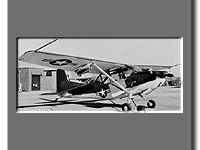
Cessna OE-2 (O-1C) 'Bird Dog II'
|
Description
|   Manufacturer: | Cessna |
|
|   Base model: | OE |
|   Designation: | OE |
|   Version: | -2 |
|   Nickname: | Bird Dog II |
|   Equivalent to: |
O-1C O1CO-1C |
|   Designation System: | U.S. Navy / Marines |
|   Designation Period: | 1922-1962 |
|   Basic role: | Observation |
|   Crew: | Pilot & Observer |
|   See Also: | |
Specifications
|   Length: | 25' 9" | 7.8 m |
|   Height: | 9' 1" | 2.7 m |
|   Wingspan: | 36' | 10.9 m |
|   Empty Weight: | 1,830 lb | 829 kg |
|   Max Weight: | 2,650 lb | 1,201 kg |
Propulsion
|   No. of Engines: | 1 |
|   Powerplant: | Continental O-470-2 |
|   Horsepower (each): | 265 |
Performance
|   Range: | 708 miles | 1,140 km |
|   Max Speed: | 185 mph | 297 km/h | 160 kt |
|   Ceiling: | 26,200 ft | 7,985 m |
Known serial numbers
| 63-12741 / 63-12744, 151776 / 151779
|
 
Recent comments by our visitors
milton starnes denver, NC | I WAS A PILOT IN THE ARMY AND WE USED THE BIRD DOG FOR PRIMARY AND TACTICAL TRAINING. I WAS ALWAYS IMPRESSED WITH ITS POWER AND SHORT FIELD CAPABILITIES. WE ALSO USED THE T0-1D FOR INSTRUMENT TRAINING. IT WAS HEAVIER BUT HAD A CONTROLLABLE PITCH PROP AND WAS FASTER THAN THE BIRD DOG. ONCE WHEN I WAS A0D AT FT BRAGG AN 02-E LANDED. I DIDN'T KNOW THERE WAS SUCH A MACHINE. I LATER FELL IN LOVE WITH THE CESSNA I82 AND FOUND THAT IT IS A CIVILIAN VERSION OF THE O-E2 BUT WITHOUT 60 DEGREES OF FLAPS. I'M LOOKING FOR A SURPLUS O-E2 TO RESTORE. DOES ANYONE KNOW THE WHEREABOUTS OF ONE? 06/19/2008 @ 11:09 [ref: 21555] |
Harry Steindorf Cottage Grove, WI | I replaced Moriarty as a Marine Bird Dog FAC(A) in July, 1969, at VMO-6, Quang Tri AB, SVN. He departed a few days before I arrived so we have never met, but we have corresponded via the web for many years. His recall is correct: we had 3-4 Charlie models and perhaps 6-7 Golfs remaining. The only strike damage we suffered from July-Oct 1969 was the one I ground-looped and broke in half! I swerved the tailwheel into one of those runway trenches at Dong Ha and the plane split. Got my attention as I stared at the sky through the windscreen.
2 Phrogs air-hoisted the 2 pieces back to QT. They planted the rear half upright in front of ProvMag-39 Hdqtrs on the base until VMO-6 left permanently for Futema in October. (Somewhere thereÕs a photo of this) They cannibalized the front half to keep the other Bird Dogs flying. Also, there was no accident board convened because, according to the XO, the O-1s were not listed on the squadronÕs aircraft inventory, so technically the plane I broke did NOT exist. I went on to fly over 170 missions in 2 1/2 months logging 222 hours in the Bird Dogs.
I preferred the Golf to the Charlie because the controls were much lighter and it seemed to roll faster. The Golf also had only 2 WP rockets under each wing instead of 3 on the Charlie. I also preferred to fly solo rather than carry an Aerial Observer in the backseat. The plane was much more nimble without 200 lbs of ballast in the rear. One slow (combat) day, we convinced 2 Army O-1 pilots to fly in trail so 2 of us Marine Bird Dogs could join up, one on each side, creating a makeshift ÔdiamondÕ formation. We flew a slo-mo pass over QT airfield and popped smoke canisters in the outside fuselage brackets to trail smoke behind us. We called it the ÒSlow Motion Diamond Pass Flyby.Ó The VMO-6 flight line crew got a real kick out of that maneuver! The Group skipper was not so impressed.
A few days before VMO-6 left country in Oct, we flew all the Bird Dogs to Da Nang in flights of 3 because most of them did not have radios anymore. I led the flights because I had recently flown for 6 months out of Da Nang AB as an A6A Intruder pilot. Most of the other O-1 pilots were from Chu Lai and had flown F-4s or A-4s. Each hop into Da Nang we touched down all 3 birds simultaneously then turned off onto the sand to quickly clear the runway for the big jets following us. Ground Control radioed I looked like a mother hen with 2 chicks glued to my wings. We parked all the planes alongside the C-130 hangar on the west side of the airfield as a VMO-6 Huey gunship picked us up and took us back to QT for the next ferry flight. I never knew what happened to the planes until Moriarty emailed me several years later. I didnÕt care at the time - I was leaving VN forever.
04/02/2008 @ 18:15 [ref: 20322] |
Mo Moriarty Cayman Kai, OTH | I was with VMO-6 from November of 1968 until July of 1969 flying the O-1C and O-1G. It seems to me we had maybe 3, maybe 4 of the Charlie models. I left in July of 1969 to fly with H&MS 17 in Da Nang. VMO-6 got orders out of country in early September of 1969.
I think they gave the remaining Golf models to the Army and flew the last of the Charlies down to Da Nang. In March of 1970 the decision was made to hand over the Charlies to the ROK Marines. I flew the last O-1C flight in March of 1970 training a ROK Marine pilot in the plane. It was the last combat flight of a Marine piston engine aircraft.
Just as a matter of record, I also was flying an observation flight in the DMZ in a Birddog in early 1969 when the last H-34 combat flight was made. It was a H&MS 16 bird doing an emergency Medevac in the DMV when a couple of NVA jumped of out of spider holes and filled the H-34 with lead. No one in the plane was injured but the plane limped off towards Con Tien trailing smoke.
I know of only one O-1C still around. It's been sitting in a hanger in Houston for 30 years waiting for someone to pour a little love and a lot of money into restoration. 01/16/2008 @ 13:42 [ref: 19321] |
Edward Soils Arcadia, TX | Some 54 years ago my Dad had a picture taken standing
next to an Bird Dog in Korea. I beleive it was 1952.
the tail number reads ARMY 01 711. Does any one know any
thing about that plane? 12/30/2007 @ 05:41 [ref: 19088] |
Tom Redmond longmont, CO | Sandra Thx for the kind words...I do have the photos and will upload them on this site soon.
If there were only 25 O-1C's made, we made a big dent in the inventory in '67. I had 9 different S/Ns in my log book and by the time we got the G model we were only flying 4 of them. Tom 12/04/2007 @ 19:45 [ref: 18797] |
Sandra Meridian, MS | Tom,
I remember that Dave held you in highest regard. He often spoke of you and loved his flying days as a USMC Bird Dog.
He was working for Lockheed Martin as a sim instructor at NAS Meridian when he died. I am sure a lot of young guns flying today, know the stories of the O1! 11/27/2007 @ 14:30 [ref: 18691] |
Tom Redmond Longmont, CO | I too served along with David Schultz in the O1-C det. in 1967 at Marble Mt.. David and I were "hootch" mates for several months. I have some pix somewhere of Dave preparing to go out to retrieve the one in the boondocks. I also have some shots from the air of the retrieval operation. Now the trick is to find and digitize them so I can make them available to the site and Sandra Schultz. I flew the F-8 for the first half of my tour and the O-1 for the last half...the O-1 was much more interesting and rewarding. It was an a/c that the supersonic set found somewhat humbling when you tried to learn to land it w/o swapping ends. 11/24/2007 @ 15:57 [ref: 18660] |
Bob Lyons San Antonio, TX | Sorry to hear about Dave Schultz. Flew with him in the
O-1C Detachment, H&MS-16. Have about 800 hrs in Bird Dogs, mostly Charlies, from November 66 to December 67. According to my log books, I flew 11 different Charlies with serial #s from 140079 to 140100.
By August 67 we were down to only 3 or 4 flyable and we received about 8 O-1G's from the Army. They had less horsepower and cruised slower, but with their fixed pitch wooden props, they could climb faster. 11/23/2007 @ 09:03 [ref: 18641] |
Sandra Schultz Meridian, MS | My husband, David, (deceased in Jan 2007) flew the O1C in VietNam in 1967. When he was flying it, the USMC only had 2 or 3 of them. I am not sure if the Air Force also flew them. He had a mechanical failure and had to land in the "badlands". They sent a squad and a mechanic to protect him and the aircraft and the mechanic repaired the aircraft so that he could fly back to Marble Mountain. The CO of the Wing was ticked because he wanted to airlift it out with a helo which Dave said would have destroyed the plane. He was an A4 pilot but always said that flying the O1 was the greatest experience. 11/17/2007 @ 07:39 [ref: 18567] |
Ed Holton Davis-Monthan AFB, Tucson, AZ | Anyone wanting Cessna L-19/OE-1/O1-B or OE-2/O1-C information may contact MSG. Hyman Baker, USMC, Retired at telephone number 407-384-3453.
MSG. Baker lives in Orlando, FL and is well known as a master "A & P." Additionally, he has built and flown the L-19/OE-1/O1-B from scratch. He is a wealth of information and experience pertaining to O1 type aircraft and has agreed to allow me to post his telephone number.
NOTE: The East Coast FMF LANT, 2nd MAW, MAG-26, VMO-1 Squadron, with OE-2 type aircrat were only stationed at Marine Air Facilities(MCAF), New River, NC and it's motto was "CAN DO." OE-2 IRAN was completed at Cherry Point MCAS, NC. West Coast VMO-6, OE-2's were stationed at Camp Pendelton, CA.
With regards to FAA propeller < engine mismatch or whatever. I have never seen or known of a catastropic failure with this causal factor. Cessna designed the OE-2 for the US Army after the Korean war to replace L-19 Bird Dog. The L-19 had poor performance in the Korean Mountains and valley terrain. High density altitude factors demanded an engine-aircraft combination with a good lifting wing that provided high performance with safety. The rugged OE-2 with it's great balance, married flight controls, airfoil, flying tail elevator and turbopowered O-470-2 engine with cowl flaps was the answer for that time peorid of aviation history. I have have never seen engineering math models or non-desructive test analysis for the OE-2 if they due exist at all. The OE-2 is and was a high performance airplane and Bush Pilots dream.
The fact is the FAA with it's myriad of regulations and bureaucratic pitfalls isn't always correct. I have flown many very highly powered aircraft like the P-51, F4U, and even the PITTS Special. Applying too much power (High Manifold Pressure)too soon on take-off can result in Torque roll over and loss of control. The envelope the OE-2 flew in was one marked hazards for sure. The only OE-2 mishaps I remember revolved around human factors - pilot error.
04/25/2007 @ 18:44 [ref: 16306] |
 
Recent photos uploaded by our visitors

 |  |   |   |   |
|