

|
Description
| Notes: Primary jet trainer (2 CREW) . Replaces T-37, formerly called ngt. | ||
| Manufacturer: | Fairchild | |
| Base model: | T-46 | |
| Designation: | T-46 | |
| Version: | A | |
| Designation System: | U.S. Air Force | |
| Designation Period: | 1948-Present | |
| Basic role: | Trainer | |
Specifications
| Not Yet Available |
Known serial numbers
Examples of this type may be found at
| Museum | City | State |
| Air Force Flight Test Center Museum | Edwards AFB | California |
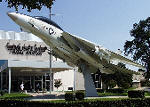
T-46A on display
Air Force Flight Test Center Museum |
Recent comments by our visitors
| Robert W Kenney Brooklyn, NY | As one of the computer graphics instructors at Republic, let me say that a tremendous effort was made to produce this aircraft. We taught CADAM, NCAD and CATIA to company personnel. They did a great job and as stated by my colleague and friend Ben Delmonte, the T-46 was the first aircraft ever to be created entirely using computer graphic technologies. From design, thru checking, tool design and numerical control machining we were the first. Unfortunately politics raised its ungly head and a delegation from Kansas lead by Bob Dole killed our program. We received little if any help from the New York representatives. They destroyed a damn fine company. Long Island has been called the Cradel of Aviation. Unfortunately that is no longer true. 07/18/2014 @ 22:03 [ref: 68568] |
| B DelMonte , CT | I also worked on this aircraft from the beginning until cancellation and also remember flight testing at Edwards AFB was just about flawless with just few minor issues.
The aircraft was very simple with mostly mechanical flight controls and very easy to maintain and operate. Some may not remember but it was also the first all digitally designed aircraft using the 2D CADAM system and 3D NCAD including electronic bill of materials. We eventually started playing with early 3D versions of CATIA prior to program being cancelled for fiscal reasons. I never heard of one bad technical comment from pilots who flew the aircraft. 02/15/2014 @ 09:29 [ref: 68346] |
| Bruce barnes , NY | My father worked on the T-46 program. Another influential senator who led the charge to kill the program was Barry Goldwater. What alot of people don't know is he took a test flight at Edwards. During the flight he had nothing but raves for the plane. Unfortunately when he got to washington politics took over. 02/16/2013 @ 14:17 [ref: 67589] |
| Bob Malanga Heathrow, FL | I was part of the Grass Roots lobbying effort for the T-46 that was iniated by John Sanford, our Division President. Everyone's comment are correct except in the end Fairchild-Republic was sold out by the Corporation. In the end we had managed to have Sen. Al D'Amato conduct a filibuster. This had gone on to 2 AM in the morning of Oct 17. We had stopped the budget from passing so technically the country ran out of money. Pres. Reagan called the Senate floor and asked that Sen. Dole, Sen. D'Amato and the rest of us convene to work out a compromise. Everyone agreed we would get Lot 1 to build, and that we would have a flyoff in one year against the T-37. D'Amato then proceeded to call our Chairman. He was in Hong Kong on vacation. The idiot he left in charge told D'Amato either we get a guarantee to build all 630 Aircraft as was the original agreement, or the Corporation didn't want to build any of the aircraft. The powers that be at the corporation were looking for a way out to get out of the Aircraft business and close Republic. Those are the facts as I was there. 07/25/2010 @ 13:51 [ref: 28389] |
| Jeffrey Black Marietta, GA | I can agree with Mr. Vitullo’s comments. I was involved in the structural engineering effort on the T-46 from the beginning to the end. At the time of cancellation, I was the structures lead for the wing, empennage and all composite material components. We had some setbacks in the fatigue life of the wing front spar and support frames, but they were easily fixed by the time the third airplane was assembled. The strength of the airframe was about to be demonstrated at program cancellation. We had analytically shown adequate “ultimate” (1.5 x anticipated flight loads) strength but had only applied “limit” (1.0 x flight loads) values to the hardware up to that point. The flutter clearance flight tests became a stumbling block when a combination of erroneous ground vibration test data, lack of time/money to repeat those tests and a crisis in confidence between the System Program Office and Fairchild engineering, caused several delays. The worst of these crises was a result of an ill advised experiment with the aileron balance weights that caused an in-flight flutter incident. Confidence in the ability of Fairchild engineering was literally and figuratively shaken. Ironically, these ailerons were of a simplified construction, only intended for fine tuning the spring tab stiffness for handling qualities. As a result of their sheet metal construction, they were twice as heavy as the production versions, and severely magnified any flutter tendencies. The third aircraft had the carbon fiber composite ailerons, which were performing satisfactorily.
I can also confirm that there was an unexpected drag increment that was discovered very early, the second flight I think, and was very puzzling to the aerodynamicists. I believe it was related to a drastic change in the inlet lip geometry that fouled up the match to the engine, and resulted in a lot of inlet “spillage” drag. This inlet lip change was mandated by another airframe/engine compatibility requirement, airflow distortion at the engine face. The distortion “problem” was identified in a scale model wind tunnel test, and was fixed in haste by trial and error. I remember the wind tunnel engineers telling me that during their experiments with new inlet configurations, massive drag increments were noticed with some of them, but they were able to find an acceptable one. Perhaps it was only acceptable at wind tunnel scale. If you study the pictures of the full scale jets versus the 62% scale demonstrator you can see the relatively grotesque, thick inlet lips on the full scale jets. The empty weight increases involved for the T-46 development were in line with historical trends, about 7%. However, because the useful load (fuel + payload) of a trainer is so small, and only fuel can be off loaded to compensate, any weight increase decreases performance across the board. Since the flight test aircraft were flying at weights in excess of predicted operational weight (due to the carriage of test equipment) without much trouble, I believe the predicted operational weights were tolerable. We had viable fixes for all shortfalls, but compromises would have probably been made to save time and money. That is common on all aircraft development programs. I am pretty sure that there was a consensus that the T-46 turned out to be the intended improvement over the T-37. The fan engines and pressurized cockpit were very well received. Handling qualities were also good in spite of a totally “muscle” powered control system (no help from hydraulics). Near the end of the program many dignitaries flew the aircraft. It was a revolving door of generals and politicians. Like Mr. Vitullo, I believe the T-46 was just the first of several defense projects, like the A-6F and F-14D, that were cancelled to relieve financial pressure caused by the concurrent ATF, B-2 and A-12 projects. 09/03/2004 @ 11:00 [ref: 8206] |
| Nick Vitullo Suffolk, VA | The cancellation of the T-46A project was much more complex than what is listed within your document. What you have listed is one of the popular scenarios as to why the project was terminated. It was mainly due to budget constraints, as well as a strong political campaign to block the aircrafts production, by 2 of the most powerful Senators of the time. Sure there were project overruns and delays, but from what I remember the plane performed beyond expectation during the testing phase. As a matter of fact it was one of the first planes to complete flight testing without any downtime as a result of the aircrafts system or overall design. There were issues, but they were greatly exaggerated and inflated in order to make the project termination palatable. The termination of the T-46 was the precursor to the recession and resulting reduction of defense spending that dominated the early 90's, in that respect we were fortunate to be the firsts to find alternate employement and or endeavors. We built a plane that met or exceeded the Air Force's requirements, and we were proud of it, unfortunately I am unable to support this point with documentation, but in the capacities that I was appointted towards the end of that project, I received daily correspondance from the Air Force out at Edwards, and to my recollection there was nothing noticibly wrong with the plane. The people of Republic Aviation were professionals to the end, and I'm proud to have been a part of that history, even though it was brief in my case, I'm just tired of the inadeqacies of stories surrounding the demise of Republic Aviation. 06/02/2004 @ 20:36 [ref: 7535] |
| Paul F. Bryk , DE | Fairchild Republic T-46A
The following information was borrowed from : (http://www.csd.uwo.ca/~pettypi/elevon/baugher_other/t-46a.html) Structure The design of the T-46A was relatively conventional, with side-by-side accomodation for the pupil and the instructor on Weber ACES II ejection seats in a pressurised cockpit. The primary structure was of light alloy, with composite control surfaces and access panels. A shoulder mounted straight wing, fitted with Fowler flaps, was employed and the T-46A had a tail assembly which featured two vertical fins. The two Garrett F109-GA-100 turbofans were designed specially for the NGT programme. Garrett was selected in July 1982 to produce the powerplant for the T-46A, which was based on the T76 (TPE331) turboprop. The engines were mounted on the fuselage sides beneath the wing roots. Cancellation During the flight test programme, a 40 per cent discrepancy between predicted and actual drag were found with consequent effects in performance. Furthermore, the T-46A was overweight, which also lead to a decrease in performance. This, combined with production delays and escaliting costs, lead to the cancellation of the programme on 13 March 1987. As a result, Fairchild Republic closed the Republic plant at Farmingdale. Specification of the Fairchild Republic T-46A Type: Two-seat side-by-side primary and basic trainer. Powerplant: Two 603 kg Garrett F109-GA-100 (TFE109) two-shaft turbofans. Fuel capacity: Internal fuel capacity: 572 kg. Performance: Maximum speed: 736 km/h at 7,620 m. Maximum cruise speed: 712 km/h at 10,670 m. Economic cruise speed: 616 km/h at 13,720 m. Maximum initial rate of climb: 22.7 m/sec. Service ceiling: 14,175 m. Ferry range: 2,130 km. Wing loading at maximum take-off weight: 207 kg/m2. Thrust-to-weight ratio at maximum take-off weight: 0.39. Take-off distance: 366 m. Landing distance: 343 m. Dimensions: Wingspan: 11.78 m. Length: 8.99 m. Height: 3.86 m. Wing area: 14.95 m2. Aspect ratio: 9.3. Weights: Empty weight: 2,351 kg. Maximum take-off weight: 3,092 kg. 07/25/2001 @ 06:18 [ref: 2751] |
Recent photos uploaded by our visitors