

|
Description
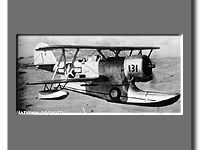
| Manufacturer: | Grumman |
| |
| Base model: | J2F | ||
| Designation: | J2F | ||
| Version: | -6 | ||
| Nickname: | Duck | ||
| Designation System: | U.S. Navy / Marines | ||
| Designation Period: | 1931-1955 | ||
| Basic role: | General Utility | ||


Specifications
| Length: | 34' | 10.3 m | |
| Height: | 15' 1" | 4.6 m | |
| Wingspan: | 39' | 11.8 m | |
| Gross Weight: | 6,709 lb | 3,043 kg | |
| Max Weight: | 6,711 lb | 3,043 kg | |
Propulsion
| No. of Engines: | 1 | ||
| Powerplant: | Wright R-1820-54 | ||
| Horsepower (each): | 1050 | ||
Performance
| Range: | 780 miles | 1,256 km | |
| Cruise Speed: | 150 mph | 241 km/h | 130 kt |
| Max Speed: | 188 mph | 302 km/h | 163 kt |
| Ceiling: | 27,000 ft | 8,229 m | |
Known serial numbers
Examples of this type may be found at
| Museum | City | State |
| National Museum of Naval Aviation | NAS Pensacola | Florida |
| San Diego Aerospace Museum | San Diego | California |
| United States Air Force Museum | Wright-Patterson | Ohio |
J2F-6 on display
National Museum of Naval Aviation | United States Air Force Museum |
Recent comments by our visitors
| Brent Conner Medford, OR | Check out our Duck at the Tillamook Air Museum in Tillamook Or, I am not sure if this is the Duck you are talking about but I know it did crash in a river. It is restored and flying 11/03/2011 @ 06:22 [ref: 49952] |
| Jim Bielefeld Kenai, AK | I believe the Duck that Frank Tallman had is the same one at Fantasy of Flight (Kermit Weeks).
It can be seen in "Murphy's War" and a couple of episodes of "Black Sheep Squadron". 06/02/2010 @ 06:40 [ref: 26535] |
| Bill Nelson Grayslake, IL | During the early 1980's several people at the Lmbertville, Michigan airport reconstructed a plane similiar to the J2F-6. This plane was finally flown by Harley Barnam in and around the Toledo area. During a local water/air show Mr Barnam tried to land the "Duck" in the Maumee River between two bridges but was unsuccessful and resulted in a crash and the plane sank. I'm wondering if you have any information on this aircraft? The renovation of the plane was outstanding and if it survived where it finally ended up. Sorry I don't have the plane serial number or any pictures. 01/21/2010 @ 16:40 [ref: 25613] |
| Wayne Dunning Seymour, MO | Read the note from John Seidel dated 12-20-09.I was in the same marina as his dad and John would land on the river and tie up at the gas dock.I had the opportunity to fly in his Duck.What a great thrill.I still think of that flight often.Taking off the water was fantastic. Wayne 'Rooster'Dunning 01/12/2010 @ 19:22 [ref: 25559] |
| george zonov , WA | I saw a all whiteJ2F with US markings flown/demonstrated (by Paul Mantz?) at the Reno Air races in the late sixties. Also, a J2F was shown at the start of the Indiana Jones film "Temple of Doom", rescue scene of Jones by J2F flown from a tropical river. Wonder if it the same plane as at Reno. 12/26/2009 @ 12:33 [ref: 25479] |
| John Seidel , WI | There is also a Duck in flying condition at the Fantasy of Flight museum in Orlando FL. Kermit Weeks did a great job in fixing it up after it was damaged in a hurricane in the 90's. My father and I had restored it back in the 70's. It had sat for years in Long Beach CA, non-flyable and repainted every so often with house paint. It had been grounded due to smuggling in the 50's-60's?. It was used in the movie"The Trial of Billy Mitchel." 12/20/2009 @ 06:43 [ref: 25442] |
| Kelvin Cubbison , OR | This is in response to the guy looking for drawings for scale landing gear for his model. I make 1/6th scale landing gear for this model and I'm also working on a 1/6th scale kit which will consist of a fiberglas fuselage and hull with built-up wings and tail feathers. If interested contact me at, kelvin@keleo-creations.com 11/17/2008 @ 06:33 [ref: 23084] |
| Rich DeMello Port Charlotte, FL | I am reserching the duck for a scale model and any information or diagrams on the operation of the landing gear will be appreciated. Any cost of copies and or postage will gladly be paid. thank you. 11/05/2008 @ 17:04 [ref: 22983] |
| Rusty Baldwin St.Petersburg, FL | I have a "Handbook of Instructions for Sructural Repair"
US Navy Model J2F-6 Airplane "Duck" This the revised updated copy. It is a revision to AN 01-220CA-3 The attached pages supercede like pages of that AN Publication.If anyone is looking contact me and I'll make you a copy. 09/08/2008 @ 12:23 [ref: 22633] |
| Clyde L. Ruthroff Mount Joy, PA | Navy utility squadrons used the J2F's before and during WWII.
In 1940 and 1941 I was an aircraft radioman in Utility Squadron VJ-2 and my brother John was an Aviation Machinist's Mate in Utility Squadron VJ-1. The J2F's were used to tow targets for ship anti-aircraft training and also for Marine Machine Gun training. They were also used to chase torpedoes and carry observers during fleet exercises. The crew consisted of a pilot and radioman. On rare occasions a third person could be carried. 02/25/2008 @ 07:10 [ref: 19775] |
Recent photos uploaded by our visitors