|


| |
Lockheed YF-12A
|
Description
|   Manufacturer: | Lockheed |
|   Base model: | F-12 |
|   Designation: | YF-12 |
|   Version: | A |
|   Designation System: | U.S. Tri-Service |
|   Designation Period: | 1962-Present |
|   Basic role: | Fighter |
|   Status: | Prototype |
Specifications
Known serial numbers
Examples of this type may be found at
 
Recent comments by our visitors
WESTON (Wes) Y. LAYTON Castle Rock, CO | Col. Layton is alive and well in Rexburg, Id. He left Colo. Spgs in the late 70s following his retirement @ Peterson Air Force Base and the 14th Air Force which is now In Vandenburg. His losing of 6936 was not on take off. This was the F-12 that suffered the in flight fuel line fracture 2 minutes from landing at Edwards in '71. A pilot's name missing in an above commentary was Mele Vojavadich (I'm certain I misspelled his last name & apologize in advance)General, Ret and has since passed away. Also an aviation pioneer and a major part of history in the developmental and testing stages of the Blackbird program. I wish all to remember that there are not many of them left on this earth and sooner then we want they will all be a memory in the history pages of aviation. It will be left to us to insure that their vaulable legacy will live on and etched in whatever stones we choose to place them. Their contributions are priceless and very few are aware of the true sacrifices they endured and even fewer are aware of the all the missions flown and the progresses made. 10/22/2006 @ 07:52 [ref: 14529] |
Ron Thurlow , MI | Does anyone know whether any of the AIM-47 missiles tested on the YF-12 have survived and if so, where one could be found? It would be nice to have one displayed next to the YF-12 at the Air Force Museum, Dayton, OH. Thanks. 10/24/2005 @ 04:27 [ref: 11554] |
Weston Layton Castle Rock, CO | Actually Jack Layton (Col. USAF Ret.) & Capt Curtis bailed out of 936 2 minutes from landing over the dry lake bed at Edwards AFB in 1971 as aforementioned above due to that catastrophic fuel line fracture. Capt Curtis was the first to eject and it was windy that day and all he could think of at that moment was losing (at that time) a $30 million dollar aircraft and then landing on the road he saw approaching and then to get hit by a vehicle! I remember that story vividly! I hope that we all remember General Mele, for he, like Col Layton were true pioneers in the blackbird / skunk works program. 02/06/2005 @ 11:27 [ref: 9375] |
George Spurling , TN | Mark Sommer,
The pods you are refering too, are camera pods to record on film the missile launches from the YF-12. 01/18/2005 @ 06:13 [ref: 9166] |
mark sommer groveport, OH | hi,
can anyone out there tell me what the two ventral extensions coming from beneath the forward underbody engine nacelle's are holding in the spike tipped pods? the only guess i can comeup with is since the YF-12A was supposed to be a fighter that these two pods were enemy radar jammers. i know the fire control radar was in the modified nose, but every book and website i've read about the A-12, YF-12A, SR-71A and M-21 do not explain these strange pods.
does anyone out there know?
sommer 03/04/2004 @ 11:30 [ref: 6894] |
jacob dees petal, MS |
[NASA Dryden Flight Research Center Fact Sheet]
THE LOCKHEED YF-12
[Image of the YF-12 in flight]
YF-12 in flight. (NASA) photo EC72-3150)
The YF-12 "Blackbird" was an experimental fighter-interceptor version of the Lockheed A-12 reconnaissance aircraft. In Air Force flight tests on May 1, 1965, the YF-12 set a speed record of 2,070.101 mph and an altitude record of 80,257.65 feet. First publicly displayed at Edwards Air Force Base in 1964, the YF-12 was never adopted by the military as an operational aircraft. It was, however, a precursor to the SR-71 Blackbird reconnaissance plane.
Two YF-12's were flown in a joint Air Force-NASA research program at the NASA Flight Research Center (after 1976, the NASA Dryden Flight Research Center) between 1969 and 1979. A third shared plane, piloted primarily by the Air Force, was lost to an in-flight fire in 1971.
The YF-12 allowed NASA researchers at all four of the agency's aeronautical centers (Langley, Lewis [now Glenn], and Ames as well as the Flight Research Center) to study the thermal, structural, and aerodynamic effects of sustained, high-altitude, Mach 3 flight.
Painted flat black, the YF-12 was fabricated primarily from titanium alloy, which enabled it to withstand skin temperatures of over 500º F.
Work on the YF-12 began in secret in the late 1950's at the Lockheed Advanced Development Projects office, better as known the "Skunk Works," in Burbank, CA. Flight data remained classified long after President Lyndon Johnson announced the plane's existence on Feb. 29, 1964. After the announcement, the plane received the Air Force designation YF-12A.
(The "Skunk Works" was the unofficial designation of Lockheed's secret development entity in Burbank. It was located near a plastics plant that exuded a rather strong odor. Since the engineers were also brewing up their secret designs, the "Skonk Works" in Al Capp's comic strip "L'il Abner," where Kickapoo Joy Juice was made, seemed an appropriate designation. However, it was changed to Skunk Works to avoid plagiarism.)
Although it yielded large amounts of research data, the YF-12 program was terminated in the late 1970's when NASA's research agenda shifted from speed to efficiency. During its 9-year life, the YF-12 research program logged 297 flights in the joint NASA-Air Force program and approximately 450 flight hours.
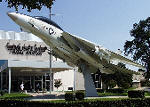
Only one YF-12 remains in existence. It is displayed at the US Air Force Museum at Wright-Patterson Air Force Base in Dayton, OH.
The Development of the "Blackbirds"
In 1959, Lockheed began work on the design of a long-range, high-altitude plane, then known as the A-11. It was a Cold War project. Heading the project team was Clarence "Kelly" Johnson, Lockheed's Vice President for Advanced Development Projects. Johnson had previously led the development of the U-2 spy plane. Five years after work began on the A-11, on February 29, 1964, President Lyndon Johnson told reporters that the aircraft (by that time modified to the A-12 production version with a reduced radar cross section) had attained speeds of over 2,000 mph and altitudes of more than 70,000 feet in tests at Edwards Air Force Base.
The Air Force YF-12 flight test program lasted until 1966 and was assigned to the 4786th Test Squadron at Edwards. The team of Col. Robert L. Stephens and Lt. Col. Daniel Andre took the plane to the record altitude and speed noted above.
On July 24, 1964, President Johnson announced that Lockheed was also developing "a long-range advanced strategic reconnaissance plane for military use, capable of world-wide reconnaissance for military operations." That plane, the SR-71, was a modified version of the YF-12. Although heavier than the YF-12, the SR-71 "spy plane" had a longer range and was capable of strategic surveillance. This spy plane was adopted by the military and the YF-12 was not. Usurped by a demand for its successor's capabilities, the experimental YF-12's were essentially shelved until 1969, when two of them were deployed as research vehicles at the NASA Flight Research Center.
Program Managers
Engineer Gene Matranga led a NASA research team that had begun studying Blackbird data in 1967. He continued to manage the project after the planes were acquired by NASA and the YF-12 project was formally initiated in 1969. In its later years, the YF-12 program had two other NASA managers, Ming Tang and Berwin Kock.
NASA YF-12 Crews
[Image of the YF-12C and YF12A in flight]
"YF-12C" (foreground) and YF-12A in flight. (NASA photo ECN-4775)
The YF-12 carried a crew of two - a pilot and a flight engineer (in Air Force parlance and practice, a fire control officer). Research pilots Fitzhugh Fulton and Donald Mallick flew NASA's YF-12 flights at the NASA Flight Research Center from 1970 to 1979, with several other pilots performing familiarization and a few research flights. The flight engineers on NASA's YF-12 crews were Victor Horton and Ray Young. Air Force crews also conducted testing.
Under its research agreement with NASA, the Air Force provided the agency with two YF-12A's in 1969. On June 24, 1971, one of the planes experienced an in-flight fuel line failure that led to a fire in the right engine. Unable to save the smoking aircraft, Air Force pilot Lt. Col. Ronald Layton and fire control officer Major Billy A. Curtis ejected and were not injured, but the YF-12A was lost in a fiery explosion in the desert. The plane was replaced by a "YF-12C." The YF-12C (so-called) differed from the YF-12A in that the A-model had a round nose while the C-model had its chine carried forward to the nose of the airplane (see three-views below). There were other differences in internal and external configuration, but the two aircraft shared common inlet designs, structural concepts, and subsystems.
In fact, the "YF-12C" was a then-secret SR-71A (serial no. 61-7951) given the NASA tail no. 60-6937. The reason for this bit of subterfuge lay in the fact that NASA, while flying the YF-12A interceptor version of the aircraft, was not allowed to possess the strategic reconnaissance version for some time. The bogus tail number actually belonged to a Lockheed A-12 (serial no. 60-6937), but the existence of the A-12 remained classified until 1982. The tail number 06937 was selected because it followed in the sequence of tail numbers assigned to the three existing YF-12A aircraft: 06934, 06935, and 06936.
The History of NASA's YF-12 project
On July 18, 1969, NASA and the Air Force announced joint involvement in a YF-12 research program. The agendas differed, with the Air Force focusing on combat research and NASA engineers initially focusing on a study of flight loads and structural heating. Much of the NASA research was concerned with the viability and development of supersonic cruise aircraft. Two YF-12As (tail numbers 935 and 936) were removed from Air Force storage for the program. On December 11, 1969, 935 successfully made its first flight as a NASA-USAF research plane and inaugurated the program. On June 24, 1971, 936 experienced the fuel line failure described above.
Unless grounded for maintenance or modification, the YF-12's flew nearly every week for most of the program's lifespan. The fiery end of 936 on the desert floor was the program's only crash, but flight crews were forced to make emergencylandings at least twice because of in-flight problems. The planes were also prone to an airflow problem involving the engine inlets called an "unstart," which caused a thrust imbalance and resulted in violent yawing.
The YF-12's ability to sustain a cruise speed of greater than Mach 3 allowed NASA to expand its research capabilities. A large amount of flight research was performed in aerodynamics, propulsion, controls, structures, subsystems and other areas such as the physics of the upper atmosphere, noise tests and measurements, and handling qualities. The YF-12 flight research data was augmented by a series of wind tunnel tests, laboratory experiments, and analyses. As a result, the combined ground/flight research generated vast amounts of information that was later incorporated into the design of other supersonic aircraft. The program yielded over 125 technical reports.
YF-12 flight tests included propulsion studies, investigations of a flight path oscillation known as phugoid, studies of the plane's loads and handling capabilities, and performance tests that involved flights with the ventral fin removed. Other research included the use of attached vanes to investigate airflow and wind gusts, studies of jet wake dispersion, engine stalls, elevation-hold at high Mach speeds, boundary layer noise, and the effect of a boattail design on drag.
The program was ordered terminated in 1977, but NASA used some residual funding to keep the project alive into 1979. Plane 935 made its last NASA flight on October 31, 1979. On November 7, 1979, it was ferried by an Air Force crew to the Air Force Museum at Wright-Patterson Air Force Base in Dayton, OH.
[Image of the YF-12A, Cold wall experiment]
YF-12A 06935 with insulated hollow cylinder used on the Cold Wall Experiment. (NASA photo ECN-4777)
The Cold Wall
Because air friction subjected the plane to extreme heat during flight, the YF-12 was also used to study high-temperature phenomena unrelated to the plane itself. Perhaps the most significant of these studies was the Cold Wall Experiment, which involved exposing a cooled cylinder to the friction and heat of a Mach 3 environment. The cylinder, which was hollow, equipped with sensors, and mounted beneath the aircraft, was cooled with liquid nitrogen and insulated from the heat that was generated during flight. When the plane neared Mach 3, a primer cord was used to blow the insulation from the frigid cylinder. Temperature, pressures, and friction readings from the cylinder in flight were compared with information developed from theoretical analysis and wind-tunnel simulation. The findings were a major achievement in fluid dynamics research.
Thermal Loads Research
[Photo of the YF-12A in the Thermal Loads Facility]
YF-12A forebody heater undergoing a lamp check in the Thermal Loads Facility. (NASA photo EC71 2789)
To measure the thermal loads on the YF-12 required some extraordinary ground tests. At the supersonic speeds the aircraft achieved, high temperatures produced by friction with the atmosphere made it difficult to separate the aerodynamic from the purely thermal effects upon the airplane. As a result, the Flight Research Center conducted one of the most complex series of tests ever done on an aircraft, combining flight and ground-facility techniques and resources. In the Thermal Loads Facility a YF-12A Mach 3 heating simulation collected an enormous data base. This led to methods for separating the aerodynamic and thermal forces operating on an aircraft - a capability that will be of great importance for the design, structural integrity, and safety of future supersonic and hypersonic aircraft. Remarkably, this research still supports one of the ten goals of NASA's Office of Aeronautics and Space Transportation Technology by providing design tools for the next generation of aircraft. In addition, with respect to the YF-12A alone, the thermal calibration on the ground corrected high-Mach-number loads data for adverse thermal effects, which frequently proved to be large and were always significant.
Specifications
[ Graphic Three View of YF-12] [ Graphic Three view of YF-12c]
Three-view of YF-12A.(left) Three-view of YF-12C.(right)
The YF-12A (tail number 935, serial number 60-6935) has a wingspan of about 55 ft., 6 in. and a length of about 101 ft., 8 in. It is roughly 18 ft., 4 in. high. The plane's maximum loaded weight was 127,000 lbs. It derived its power from two Pratt & Whitney J58s, each with 32,000 lbs of thrust (as rated at sea level) with afterburners. However, a significant portion of the thrust as the aircraft neared Mach 3 speeds came from the supersonic shock wave captured within each engine inlet and exited through the engine nozzles.
The YF-12 carried a two-person crew, had a maximum speed of Mach 3.2 and a range of more than 2,000 miles. Its service ceiling was above 80,000 ft.
Pilots in the Joint NASA/USAF Program
Pilots Affiliation
Maj. William J. Campbell USAF
William H. Dana NASA Dryden Flight Research Center (DFRC)
Einar K. Enevoldson NASA DFRC
Maj. Mervin L. Evenson USAF
Fitzhugh L. Fulton NASA DFRC
Stephen D. Ishmael NASA DFRC
Lt. Col. Calvin F. Jewett USAF
Gary E. Krier NASA DFRC
Lt. Col. Ronald J. Layton USAF
Donald L. Mallick NASA DFRC
John A. Manke NASA DFRC
Thomas C. McMurtry NASA DFRC
Col. Joseph W. Rogers USAF
Col. Hugh C. Slater USAF
Col. James V. Sullivan USAF
Michael R. Swann NASA DFRC
Fire Control Officers/Test Engineers
Name Affiliation
Lorenzo C. Barnett NASA DFRC
Maj. Billy A. Curtis USAF
Maj. William J. Frazier USAF
Maj. Gary I Heidelbaugh USAF
Victor W. Horton NASA DFRC
Col. R. Uppstrom USAF
Maj. Sammel M. Ursini USAF
William R. Young NASA DFRC
Sources
The Dryden Historical Reference Collection, including a flight log compiled by Peter Merlin.
Francillon, Rene J. Lockheed Aircraft since 1913. Annapolis, MD : Naval Institute Press, 1987.
Hallion, Richard. On the Frontier : Flight Research at Dryden, 1946-1981. Washington, DC : NASA SP-4303, 1984.
Jane's All the World's Aircraft, 1970-1971. John W. R. Taylor, ed. New York: McGraw-Hill.
Jenkins, Dennis R. Lockheed SR-71/YF-12 Blackbirds. North Branch, MN: Specialty Press, 1997.
Kock, Berwin M. "Overview of the NASA YF-12 Program," YF-12 Experiments Symposium, Vol. 1. 3 vols.; Washington, DC: NASA CP-2054, 1978.
Quinn, Robert D. and Frank V. Olinger. "Flight Temperatures and Thermal Simulation Requirements," NASA YF-12 Flight Loads Program. Washington, DC: NASA TM X-3061, 1974, pp. 145-183.
The US Air Force Museum http://www.wpafb.af.mil/museum/an12.htm
Wallace, Lane E. Flights of Discovery : 50 years at the NASA Dryden Flight Research Center. Washington, DC : NASA SP-4309, 1996.
NASA Dryden Flight Research Center
Public Affairs Office
Edwards, CA 93523
(661)276-3449
FAX (661)276-3566
Document number: FS-1999-12-047 DFRC
Responsible NASA Official: Jenny Baer-Riedhart
PAO Webmasters
Last modified: October 1999
07/27/2002 @ 17:36 [ref: 5379] |
jacob dees petal, MS |
[NASA Dryden Flight Research Center Fact Sheet]
THE LOCKHEED YF-12
[Image of the YF-12 in flight]
YF-12 in flight. (NASA) photo EC72-3150)
The YF-12 "Blackbird" was an experimental fighter-interceptor version of the Lockheed A-12 reconnaissance aircraft. In Air Force flight tests on May 1, 1965, the YF-12 set a speed record of 2,070.101 mph and an altitude record of 80,257.65 feet. First publicly displayed at Edwards Air Force Base in 1964, the YF-12 was never adopted by the military as an operational aircraft. It was, however, a precursor to the SR-71 Blackbird reconnaissance plane.
Two YF-12's were flown in a joint Air Force-NASA research program at the NASA Flight Research Center (after 1976, the NASA Dryden Flight Research Center) between 1969 and 1979. A third shared plane, piloted primarily by the Air Force, was lost to an in-flight fire in 1971.
The YF-12 allowed NASA researchers at all four of the agency's aeronautical centers (Langley, Lewis [now Glenn], and Ames as well as the Flight Research Center) to study the thermal, structural, and aerodynamic effects of sustained, high-altitude, Mach 3 flight.
Painted flat black, the YF-12 was fabricated primarily from titanium alloy, which enabled it to withstand skin temperatures of over 500º F.
Work on the YF-12 began in secret in the late 1950's at the Lockheed Advanced Development Projects office, better as known the "Skunk Works," in Burbank, CA. Flight data remained classified long after President Lyndon Johnson announced the plane's existence on Feb. 29, 1964. After the announcement, the plane received the Air Force designation YF-12A.
(The "Skunk Works" was the unofficial designation of Lockheed's secret development entity in Burbank. It was located near a plastics plant that exuded a rather strong odor. Since the engineers were also brewing up their secret designs, the "Skonk Works" in Al Capp's comic strip "L'il Abner," where Kickapoo Joy Juice was made, seemed an appropriate designation. However, it was changed to Skunk Works to avoid plagiarism.)
Although it yielded large amounts of research data, the YF-12 program was terminated in the late 1970's when NASA's research agenda shifted from speed to efficiency. During its 9-year life, the YF-12 research program logged 297 flights in the joint NASA-Air Force program and approximately 450 flight hours.
Only one YF-12 remains in existence. It is displayed at the US Air Force Museum at Wright-Patterson Air Force Base in Dayton, OH.
The Development of the "Blackbirds"
In 1959, Lockheed began work on the design of a long-range, high-altitude plane, then known as the A-11. It was a Cold War project. Heading the project team was Clarence "Kelly" Johnson, Lockheed's Vice President for Advanced Development Projects. Johnson had previously led the development of the U-2 spy plane. Five years after work began on the A-11, on February 29, 1964, President Lyndon Johnson told reporters that the aircraft (by that time modified to the A-12 production version with a reduced radar cross section) had attained speeds of over 2,000 mph and altitudes of more than 70,000 feet in tests at Edwards Air Force Base.
The Air Force YF-12 flight test program lasted until 1966 and was assigned to the 4786th Test Squadron at Edwards. The team of Col. Robert L. Stephens and Lt. Col. Daniel Andre took the plane to the record altitude and speed noted above.
On July 24, 1964, President Johnson announced that Lockheed was also developing "a long-range advanced strategic reconnaissance plane for military use, capable of world-wide reconnaissance for military operations." That plane, the SR-71, was a modified version of the YF-12. Although heavier than the YF-12, the SR-71 "spy plane" had a longer range and was capable of strategic surveillance. This spy plane was adopted by the military and the YF-12 was not. Usurped by a demand for its successor's capabilities, the experimental YF-12's were essentially shelved until 1969, when two of them were deployed as research vehicles at the NASA Flight Research Center.
Program Managers
Engineer Gene Matranga led a NASA research team that had begun studying Blackbird data in 1967. He continued to manage the project after the planes were acquired by NASA and the YF-12 project was formally initiated in 1969. In its later years, the YF-12 program had two other NASA managers, Ming Tang and Berwin Kock.
NASA YF-12 Crews
[Image of the YF-12C and YF12A in flight]
"YF-12C" (foreground) and YF-12A in flight. (NASA photo ECN-4775)
The YF-12 carried a crew of two - a pilot and a flight engineer (in Air Force parlance and practice, a fire control officer). Research pilots Fitzhugh Fulton and Donald Mallick flew NASA's YF-12 flights at the NASA Flight Research Center from 1970 to 1979, with several other pilots performing familiarization and a few research flights. The flight engineers on NASA's YF-12 crews were Victor Horton and Ray Young. Air Force crews also conducted testing.
Under its research agreement with NASA, the Air Force provided the agency with two YF-12A's in 1969. On June 24, 1971, one of the planes experienced an in-flight fuel line failure that led to a fire in the right engine. Unable to save the smoking aircraft, Air Force pilot Lt. Col. Ronald Layton and fire control officer Major Billy A. Curtis ejected and were not injured, but the YF-12A was lost in a fiery explosion in the desert. The plane was replaced by a "YF-12C." The YF-12C (so-called) differed from the YF-12A in that the A-model had a round nose while the C-model had its chine carried forward to the nose of the airplane (see three-views below). There were other differences in internal and external configuration, but the two aircraft shared common inlet designs, structural concepts, and subsystems.
In fact, the "YF-12C" was a then-secret SR-71A (serial no. 61-7951) given the NASA tail no. 60-6937. The reason for this bit of subterfuge lay in the fact that NASA, while flying the YF-12A interceptor version of the aircraft, was not allowed to possess the strategic reconnaissance version for some time. The bogus tail number actually belonged to a Lockheed A-12 (serial no. 60-6937), but the existence of the A-12 remained classified until 1982. The tail number 06937 was selected because it followed in the sequence of tail numbers assigned to the three existing YF-12A aircraft: 06934, 06935, and 06936.
The History of NASA's YF-12 project
On July 18, 1969, NASA and the Air Force announced joint involvement in a YF-12 research program. The agendas differed, with the Air Force focusing on combat research and NASA engineers initially focusing on a study of flight loads and structural heating. Much of the NASA research was concerned with the viability and development of supersonic cruise aircraft. Two YF-12As (tail numbers 935 and 936) were removed from Air Force storage for the program. On December 11, 1969, 935 successfully made its first flight as a NASA-USAF research plane and inaugurated the program. On June 24, 1971, 936 experienced the fuel line failure described above.
Unless grounded for maintenance or modification, the YF-12's flew nearly every week for most of the program's lifespan. The fiery end of 936 on the desert floor was the program's only crash, but flight crews were forced to make emergencylandings at least twice because of in-flight problems. The planes were also prone to an airflow problem involving the engine inlets called an "unstart," which caused a thrust imbalance and resulted in violent yawing.
The YF-12's ability to sustain a cruise speed of greater than Mach 3 allowed NASA to expand its research capabilities. A large amount of flight research was performed in aerodynamics, propulsion, controls, structures, subsystems and other areas such as the physics of the upper atmosphere, noise tests and measurements, and handling qualities. The YF-12 flight research data was augmented by a series of wind tunnel tests, laboratory experiments, and analyses. As a result, the combined ground/flight research generated vast amounts of information that was later incorporated into the design of other supersonic aircraft. The program yielded over 125 technical reports.
YF-12 flight tests included propulsion studies, investigations of a flight path oscillation known as phugoid, studies of the plane's loads and handling capabilities, and performance tests that involved flights with the ventral fin removed. Other research included the use of attached vanes to investigate airflow and wind gusts, studies of jet wake dispersion, engine stalls, elevation-hold at high Mach speeds, boundary layer noise, and the effect of a boattail design on drag.
The program was ordered terminated in 1977, but NASA used some residual funding to keep the project alive into 1979. Plane 935 made its last NASA flight on October 31, 1979. On November 7, 1979, it was ferried by an Air Force crew to the Air Force Museum at Wright-Patterson Air Force Base in Dayton, OH.
[Image of the YF-12A, Cold wall experiment]
YF-12A 06935 with insulated hollow cylinder used on the Cold Wall Experiment. (NASA photo ECN-4777)
The Cold Wall
Because air friction subjected the plane to extreme heat during flight, the YF-12 was also used to study high-temperature phenomena unrelated to the plane itself. Perhaps the most significant of these studies was the Cold Wall Experiment, which involved exposing a cooled cylinder to the friction and heat of a Mach 3 environment. The cylinder, which was hollow, equipped with sensors, and mounted beneath the aircraft, was cooled with liquid nitrogen and insulated from the heat that was generated during flight. When the plane neared Mach 3, a primer cord was used to blow the insulation from the frigid cylinder. Temperature, pressures, and friction readings from the cylinder in flight were compared with information developed from theoretical analysis and wind-tunnel simulation. The findings were a major achievement in fluid dynamics research.
Thermal Loads Research
[Photo of the YF-12A in the Thermal Loads Facility]
YF-12A forebody heater undergoing a lamp check in the Thermal Loads Facility. (NASA photo EC71 2789)
To measure the thermal loads on the YF-12 required some extraordinary ground tests. At the supersonic speeds the aircraft achieved, high temperatures produced by friction with the atmosphere made it difficult to separate the aerodynamic from the purely thermal effects upon the airplane. As a result, the Flight Research Center conducted one of the most complex series of tests ever done on an aircraft, combining flight and ground-facility techniques and resources. In the Thermal Loads Facility a YF-12A Mach 3 heating simulation collected an enormous data base. This led to methods for separating the aerodynamic and thermal forces operating on an aircraft - a capability that will be of great importance for the design, structural integrity, and safety of future supersonic and hypersonic aircraft. Remarkably, this research still supports one of the ten goals of NASA's Office of Aeronautics and Space Transportation Technology by providing design tools for the next generation of aircraft. In addition, with respect to the YF-12A alone, the thermal calibration on the ground corrected high-Mach-number loads data for adverse thermal effects, which frequently proved to be large and were always significant.
Specifications
[ Graphic Three View of YF-12] [ Graphic Three view of YF-12c]
Three-view of YF-12A.(left) Three-view of YF-12C.(right)
The YF-12A (tail number 935, serial number 60-6935) has a wingspan of about 55 ft., 6 in. and a length of about 101 ft., 8 in. It is roughly 18 ft., 4 in. high. The plane's maximum loaded weight was 127,000 lbs. It derived its power from two Pratt & Whitney J58s, each with 32,000 lbs of thrust (as rated at sea level) with afterburners. However, a significant portion of the thrust as the aircraft neared Mach 3 speeds came from the supersonic shock wave captured within each engine inlet and exited through the engine nozzles.
The YF-12 carried a two-person crew, had a maximum speed of Mach 3.2 and a range of more than 2,000 miles. Its service ceiling was above 80,000 ft.
Pilots in the Joint NASA/USAF Program
Pilots Affiliation
Maj. William J. Campbell USAF
William H. Dana NASA Dryden Flight Research Center (DFRC)
Einar K. Enevoldson NASA DFRC
Maj. Mervin L. Evenson USAF
Fitzhugh L. Fulton NASA DFRC
Stephen D. Ishmael NASA DFRC
Lt. Col. Calvin F. Jewett USAF
Gary E. Krier NASA DFRC
Lt. Col. Ronald J. Layton USAF
Donald L. Mallick NASA DFRC
John A. Manke NASA DFRC
Thomas C. McMurtry NASA DFRC
Col. Joseph W. Rogers USAF
Col. Hugh C. Slater USAF
Col. James V. Sullivan USAF
Michael R. Swann NASA DFRC
Fire Control Officers/Test Engineers
Name Affiliation
Lorenzo C. Barnett NASA DFRC
Maj. Billy A. Curtis USAF
Maj. William J. Frazier USAF
Maj. Gary I Heidelbaugh USAF
Victor W. Horton NASA DFRC
Col. R. Uppstrom USAF
Maj. Sammel M. Ursini USAF
William R. Young NASA DFRC
Sources
The Dryden Historical Reference Collection, including a flight log compiled by Peter Merlin.
Francillon, Rene J. Lockheed Aircraft since 1913. Annapolis, MD : Naval Institute Press, 1987.
Hallion, Richard. On the Frontier : Flight Research at Dryden, 1946-1981. Washington, DC : NASA SP-4303, 1984.
Jane's All the World's Aircraft, 1970-1971. John W. R. Taylor, ed. New York: McGraw-Hill.
Jenkins, Dennis R. Lockheed SR-71/YF-12 Blackbirds. North Branch, MN: Specialty Press, 1997.
Kock, Berwin M. "Overview of the NASA YF-12 Program," YF-12 Experiments Symposium, Vol. 1. 3 vols.; Washington, DC: NASA CP-2054, 1978.
Quinn, Robert D. and Frank V. Olinger. "Flight Temperatures and Thermal Simulation Requirements," NASA YF-12 Flight Loads Program. Washington, DC: NASA TM X-3061, 1974, pp. 145-183.
The US Air Force Museum http://www.wpafb.af.mil/museum/an12.htm
Wallace, Lane E. Flights of Discovery : 50 years at the NASA Dryden Flight Research Center. Washington, DC : NASA SP-4309, 1996.
NASA Dryden Flight Research Center
Public Affairs Office
Edwards, CA 93523
(661)276-3449
FAX (661)276-3566
Document number: FS-1999-12-047 DFRC
Responsible NASA Official: Jenny Baer-Riedhart
PAO Webmasters
Last modified: October 1999
07/27/2002 @ 17:35 [ref: 5378] |
G.henriques , NY | this aircraft was so far ahead of its time that the government including the air force had no idea what to do with it. subsequently this awesome aircraft was never operational. but the abilities that it had were immense.
the hughes gar-9 missile was the most succesful new weapons system ever, hitting something like 15 of 16 airborne targets at varying altitudes and speeds (in excess of 3.2mach). but various officials in the administration helped kill the f-12 before it got to prove its worth......what a pity!!!!
01/07/2002 @ 18:40 [ref: 4008] |
CLARK CORBIN COLORADO SPRINGS, CO | I THINK I HAVE SEEN A MOVIE OF THIS AIRCRAFT
CRASHING ON TAKE OFF AFTER 1 AFTERBURNER
FAILED TO LIGHT OFF CAUSING IT TO YAW HEAVY
TO PORT, ROLL INVERTED AND DIVE INTO THE GROUND. BOTH CREWMAN EJECTED AND SURVIVED . IT WAS PILOTED BY COL. JACK LAYTON
WHO IS ALSO CREDITED (I THINK) WITH THE
DISCOVERY OF THE USS PUEBLO THAT HAD BEEN
CAPTURED BY THE N KOREANS PRIOR TO THE
KOREAN WAR. HE STILL HAS THE LEFT SIDE COCKPIT WINDOW OF THE AIRCRAFT HANGING ON
HIS WALL. I LOST TRACK OF HIM AS I WAS GROWING
UP AND HE HAS SINCE MOVED.
03/15/2001 @ 15:26 [ref: 1826] |
 
Recent photos uploaded by our visitors
|