

|
Description
| Manufacturer: | Northrop | |
| Base model: | F-89 | |
| Designation: | F-89 | |
| Version: | D | |
| Nickname: | Scorpion | |
| Designation System: | U.S. Air Force | |
| Designation Period: | 1948-Present | |
| Basic role: | Fighter | |
| Crew: | Pilot | |
| See Also: | ||
Specifications
| Length: | 53' 10" | 16.4 m | |
| Height: | 17' 7" | 5.3 m | |
| Wingspan: | 59' 8" | 18.1 m | |
| Wingarea: | 562.0 sq ft | 52.2 sq m | |
| Empty Weight: | 25,194 lb | 11,425 kg | |
| Gross Weight: | 42,241 lb | 19,156 kg | |
Propulsion
| No. of Engines: | 2 | ||
| Powerplant: | Allison J35-A-35 (A/B 7,200Lb) | ||
| Thrust (each): | 5,440 lb | 2,467 kg | |
Performance
| Range: | 1,370 miles | 2,206 km | |
| Cruise Speed: | 523 mph | 842 km/h | 455 kt |
| Max Speed: | 636 mph | 1,024 km/h | 553 kt |
| Climb: | 8,360 ft/min | 2,548 m/min | |
| Ceiling: | 49,200 ft | 14,995 m | |
Known serial numbers
Examples of this type may be found at
| Museum | City | State |
| Air Force Flight Test Center Museum | Edwards AFB | California |
| Museum of Aviation | Warner Robins AFB | Georgia |
| Tyndall Air Park | Tyndall AFB | Florida |
| Vermont ANG - 158th FG, Burlington | Burlington | Vermont |
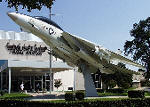
F-89D on display
Vermont ANG - 158th FG, Burlington |
Recent comments by our visitors
| Lemoine , WV | Medic in the Flight Surgeon's Ofiice, 5001st USAF Hospital, Ladd AFB, Aug 55 to Dec 57. A F89 had a flame out on take off, crashed into a housing unit. Pilot survived even though he suffered severe burns, was later returned to duty. There were several civilian deaths however.
06/22/2015 @ 02:58 [ref: 69137] |
| Fritz Busch Fort Wayne, IN | Ancient history...
I flew the D, H & J models Quite comfortable, even in rough weather / of the many different planes I've flown, easiest to hold in position when flying very tight formation - also, easiest to land softly Very stable platform for launching air-to-air rockets / Genies on J model made it extremely effective 07/10/2014 @ 09:00 [ref: 68557] |
| Bill Smar Chicago, IL | I was a crew chief on the F-89D at Kinross AFB Mich.I sure enjoyed the job and the plane. Had a few good rides in her.
had some good friends at that base and some good memories. Thanks! 02/28/2014 @ 15:40 [ref: 68379] |
| Ron Patterson , OH | I was a F-89D crew chief during the period 1956-1957 at Ladd AFB, Alaska. 12/28/2012 @ 00:23 [ref: 67446] |
| GALEN BURKE IRVING, TX | I had the privilege to serve as the RIO (A/C 59-17N), and returned as a Pilot when I was permitted to attend 64-F, Craig AFB. I have two pictures of the F-89D, firing rockets over Lake Michigan (WI ANG, Madison), and a formation of a B-52 and a F-89J. Then, someone begged me to join Braniff and so I left the ANG, to become a flight engineer.... 01/11/2012 @ 15:15 [ref: 51891] |
| GALEN BURKE IRVING, TX | I had the privilege to serve as the RIO (A/C 59-17N), and returned as a Pilot when I was permitted to attend 64-F, Craig AFB. I have two pictures of the F-89D, firing rockets over Lake Michigan (WI ANG, Madison), and a formation of a B-52 and a F-89J. Then, someone begged me to join Braniff and so I left the ANG, to become a flight engineer.... 01/11/2012 @ 15:14 [ref: 51889] |
| GALEN BURKE IRVING, TX | I had the privilege to serve as the RIO (A/C 59-17N), and returned as a Pilot when I was permitted to attend 64-F, Craig AFB. I have two pictures of the F-89D, firing rockets over Lake Michigan (WI ANG, Madison), and a formation of a B-52 and a F-89J. Then, someone begged me to join Braniff and so I left the ANG, to become a flight engineer.... 01/11/2012 @ 15:14 [ref: 51890] |
| GALEN BURKE IRVING, TX | I had the privilege to serve as the RIO (A/C 59-17N), and returned as a Pilot when I was permitted to attend 64-F, Craig AFB. I have two pictures of the F-89D, firing rockets over Lake Michigan (WI ANG, Madison), and a formation of a B-52 and a F-89J. Then, someone begged me to join Braniff and so I left the ANG, to become a flight engineer.... 01/11/2012 @ 15:14 [ref: 51888] |
| GALEN BURKE IRVING, TX | I had the privilege to serve as the RIO (A/C 59-17N), and returned as a Pilot when I was permitted to attend 64-F, Craig AFB. I have two pictures of the F-89D, firing rockets over Lake Michigan (WI ANG, Madison), and a formation of a B-52 and a F-89J. Then, someone begged me to join Braniff and so I left the ANG, to become a flight engineer.... 01/11/2012 @ 15:14 [ref: 51887] |
| GALEN BURKE IRVING, TX | I had the privilege to serve as the RIO (A/C 59-17N), and returned as a Pilot when I was permitted to attend 64-F, Craig AFB. I have two pictures of the F-89D, firing rockets over Lake Michigan (WI ANG, Madison), and a formation of a B-52 and a F-89J. Then, someone begged me to join Braniff and so I left the ANG, to become a flight engineer.... 01/11/2012 @ 15:14 [ref: 51886] |
Recent photos uploaded by our visitors